
Chordle allows you to share songs and set lists in a couple of different ways:
- Exporting to a file that you can use as a backup or sharing by a memory stick
- Using sharing functions built into your device to share directly with nearby devices or apps
Both exporting and sharing follow the same general process. These instructions show you how to export songs, but you can do exactly the same for set lists by starting from your set list library.
From your song or set list library, select the songs or set lists that you want to export or share, and then press the Export or Share button in the toolbar.
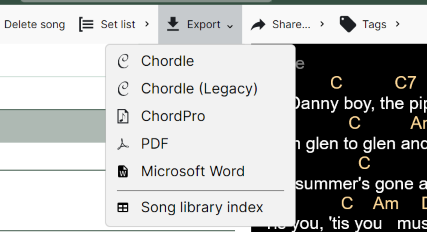
- Chordle - This is the best option if you want to share songs with another Chordle user, or if you want to back up your songs in a format that can be easily imported back into Chordle.
- Chordle (Legacy) - Use this if you need to share songs with another Chordle user who is using an older version of Chordle (v2) that doesn’t support the latest Chordle format. Avoid using this format if you don’t need to, as it doesn’t support all the features of the latest Chordle format.
- ChordPro - This format is widely supported by other song management software, so it’s a good option if you want to share songs with someone who doesn’t use Chordle, or if you want to export your songs in a format that can be easily imported into other software.
- PDF - Use this if you want to print, or share your songs with someone in PDF format.
- Microsoft Word - Use this if you want to print, or share the songs with someone in Microsoft Word format.
Exporting to PDF
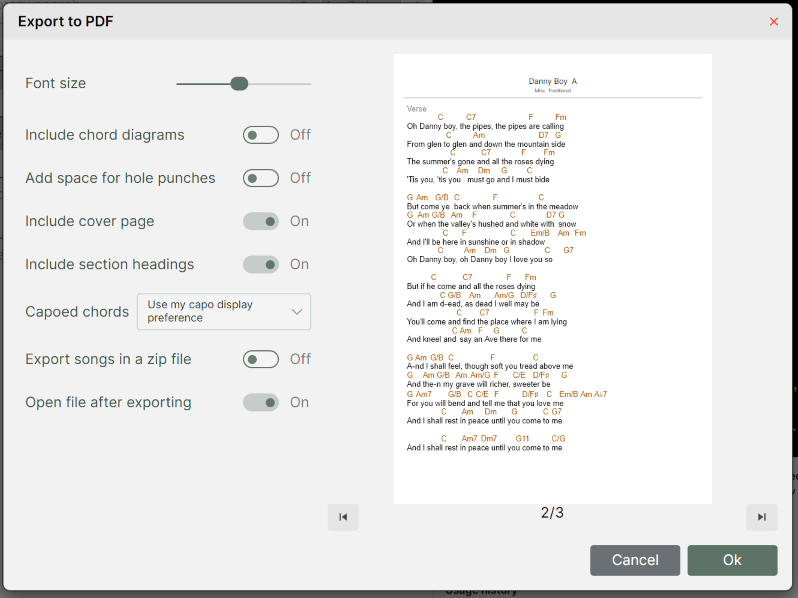
- Font size - Adjust the font size of the exported PDF. This only affects the body of the song. Use it to make the song fit better on the page, or to make it easier to read when printed.
- Include chord diagrams - When enabled, every song will have chord diagrams added to the bottom of their first page.
- Add space for hole punches - When enabled, adds extra space to the left of the page to allow for hole punching and binding.
- Include cover page - When enabled, adds a cover page to the exported PDF with a list of the songs in it.
- Include section headings - When enabled, includes section headings in the exported song text, e.g. Verse, Chorus.
- Capoed chords:
- Capoed chord versions of songs only - only the capoed versions of chords will be included in the export.
- Uncapoed chord versions of songs only - only the uncapoed versions of chords will be included in the export.
- Include both capoed and uncapoed chord versions of songs - both the capoed and uncapoed versions of chords will be included in the export. Songs that have a capo applied will be duplicated, once with capoed chords and once with uncapoed chords.
- Use my capo display preference - your song presentation preference for capo display will be used to determine which chord versions are included in the export.
- Export songs in a zip file - When enabled, each song will be exported as a separate PDF file, and all the files will be included in a zip file for easy sharing. When disabled, all the songs will be exported into a single combined PDF file.
- Open file after exporting - When enabled, the exported file will be automatically opened after export. This is a good way to quickly print the exported PDF.
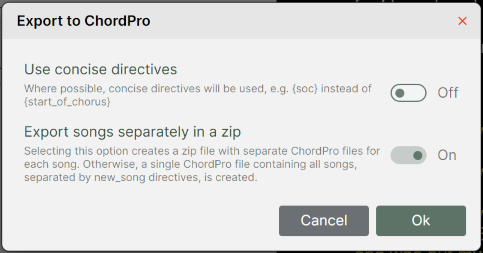
Exporting to ChordPro
Exporting to Microsoft Word
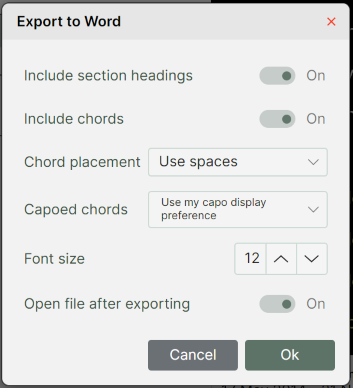
- Include section headings - When enabled, section headings will be included in the exported Word document, e.g. Verse, Chorus.
- Include chords - When enabled, chords will be included in the exported Word document. When disabled, only the lyrics will be included.
- Chord placement - When chords are included this setting determines how they are arranged:
- Use spaces - Spaces are used to position the chords above the lyrics. This is the most common way to display chords in a Word document, however it can sometimes lead to chords being misaligned with the lyrics if there are multiple consecutive spaces in the lyrics.
- Use tab stops - Tab stops are used to position the chords above the lyrics.
- Font size - Adjust the font size of the exported Word document.
- Export songs in a zip file - When enabled, each song will be exported as a separate Word file, and all the files will be included in a zip file for easy sharing. When disabled, all the songs will be exported into a single combined Word document.
- Open file after exporting - When enabled, the exported file will be automatically opened after export. This is a good way to quickly review, edit or print the exported Word document.
Quick export from the song player
While playing a song, you can quickly export it to Word or PDF directly from the song player menu - without going through the song library. This is useful for quickly printing a song in whatever transposed state it’s currently in. The export uses your current display settings, including any key transposition or capo you have applied.
To use this, open the song player menu (the Manage (⋮) button) and select Open current song then Microsoft Word or PDF. The file will be exported and opened immediately in your default app for that file type (Word or a compatible app for .docx, your PDF viewer for .pdf).
Device to device sharing
When sharing songs and set lists using system sharing, the options that you have will vary depending on your device’s capabilities and installed software. One of these options may be sharing with nearby devices - with this feature you can share songs and set lists without emailing or exporting them first. See Microsoft’s documentation for Windows, or Google’s documentation for Android, for more information about this feature.
It is possible to share across platforms, e.g. Android to Windows or vice versa, however it typically requires additional software to be installed on both devices, such as Quick Share.