
Chordle has 3 ways of displaying songs, each with its own benefits:
Fit to screen
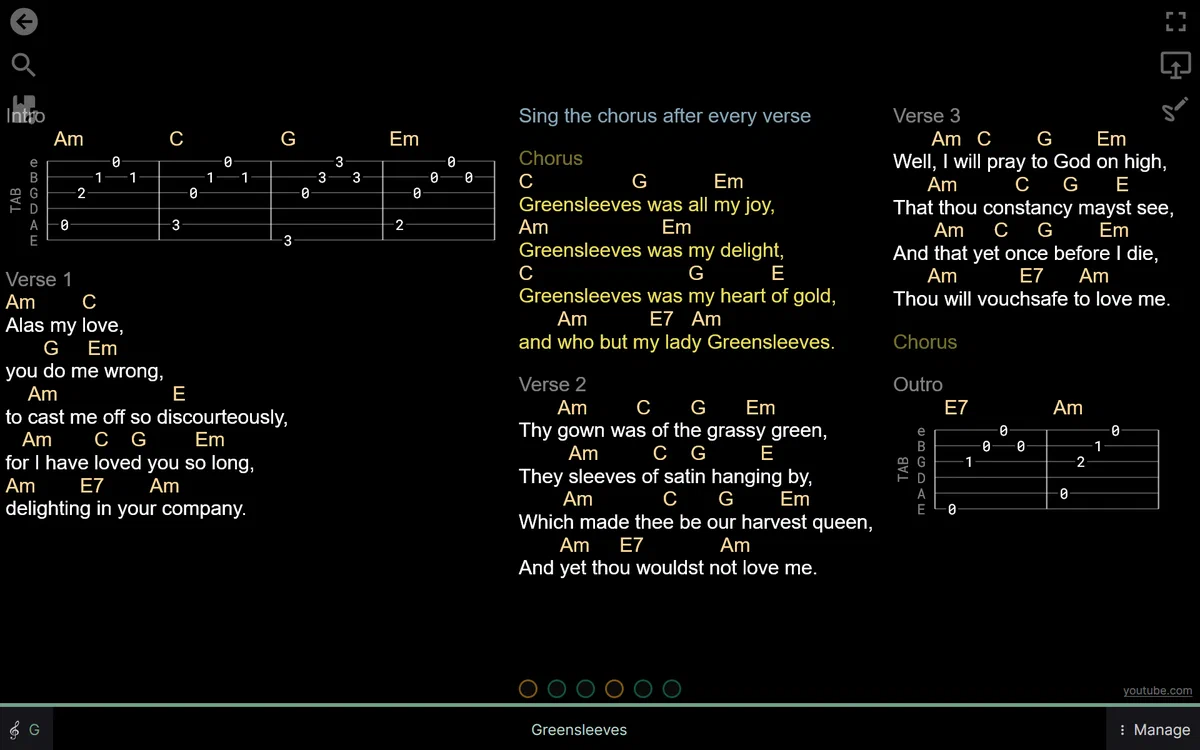
This is the default mode. Chordle arranges all song sections so they fit on screen as well as possible.
This approach means you don’t have to scroll around to find the part of the song you’re currently playing. For particularly long songs, however, Chordle may need to reduce text size so everything fits on screen. To save space, refer back to a repeated section instead of writing it out again. In
ChordPro this is {chorus}. In Chords above text, write “Chorus” as a heading, and Chordle will understand that this is the same section as the previous chorus.
Paginated
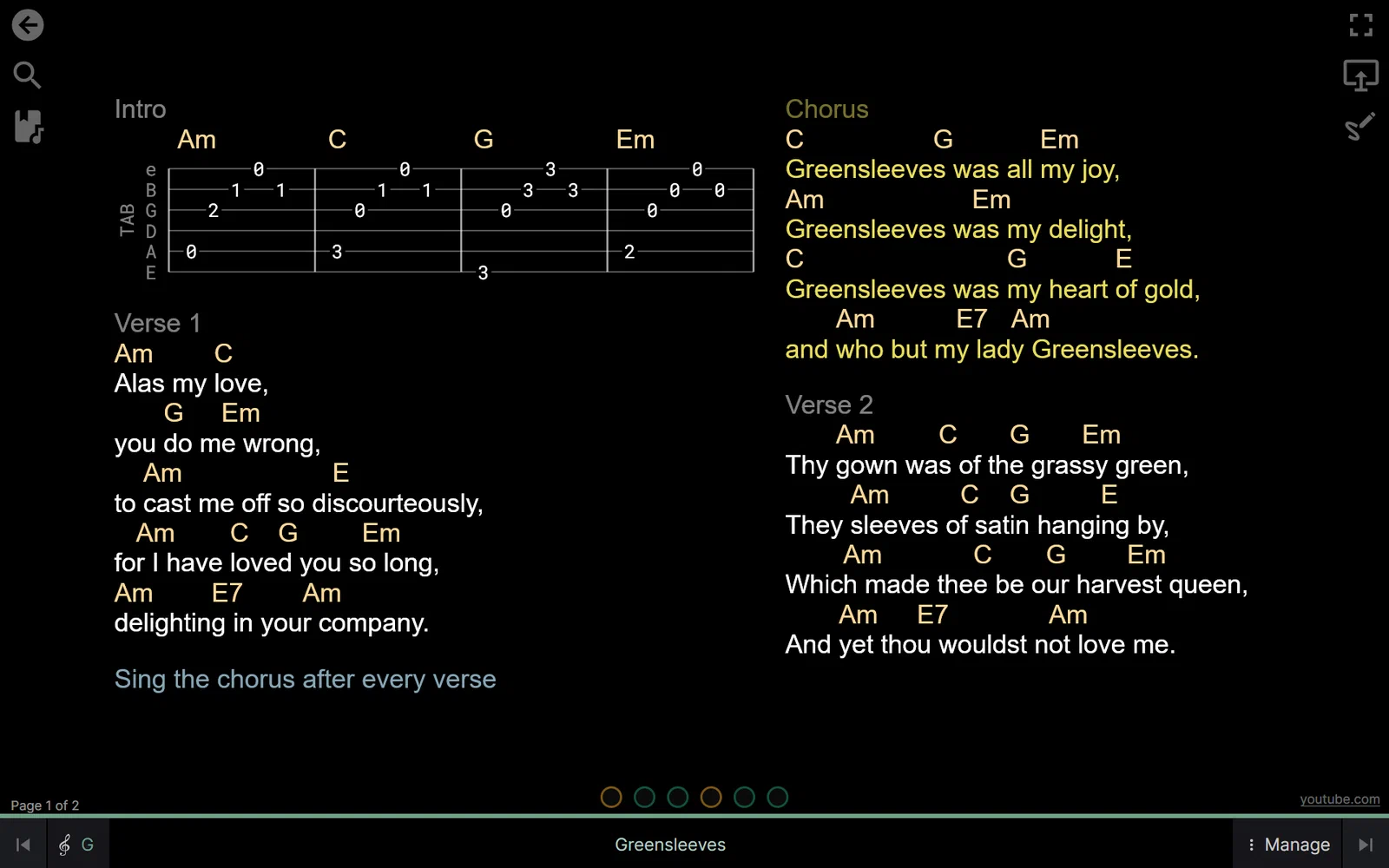
In paginated mode, Chordle still fits as much of the song on screen as it can. If the song won’t fit without shrinking, Chordle splits it into pages.
Scrolling
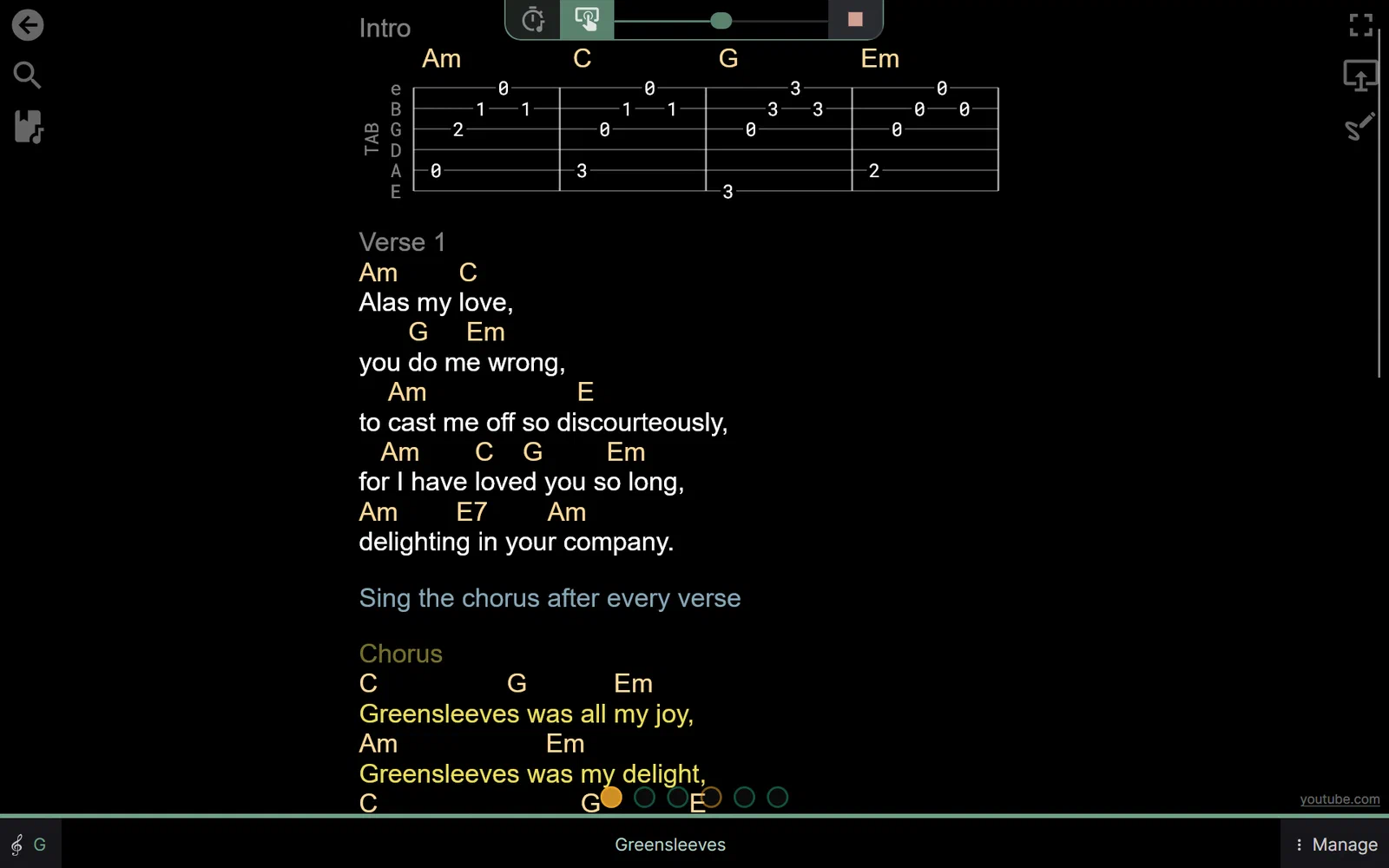
When playing a song in scrolling mode, you can start playback by tapping the play button at the top of the screen. This is also where you can adjust scrolling speed.
You can also pause, resume, and control scrolling speed using keyboard or pedal shortcuts.
You can also specify the duration of the song in its metadata if you want the song to scroll for a fixed amount of time.
Chord overlap mode
When chords take up more space than the lyrics beneath them, Chordle needs to decide how to handle the overlap. You can choose between 2 modes in the song presentation settings:
- Hyphenate (default) - the word beneath the chord is split, with a connecting line drawn across the gap to show the word continues. This keeps chords directly above their intended text position.
- Move chords - lyrics are never split or pushed apart. Instead, chords drift rightward as needed to avoid overlapping each other, then snap back to their text anchor as soon as space allows. This is particularly useful for scripts like Thai or Japanese where word-splitting is not appropriate.
Switching between presentation formats
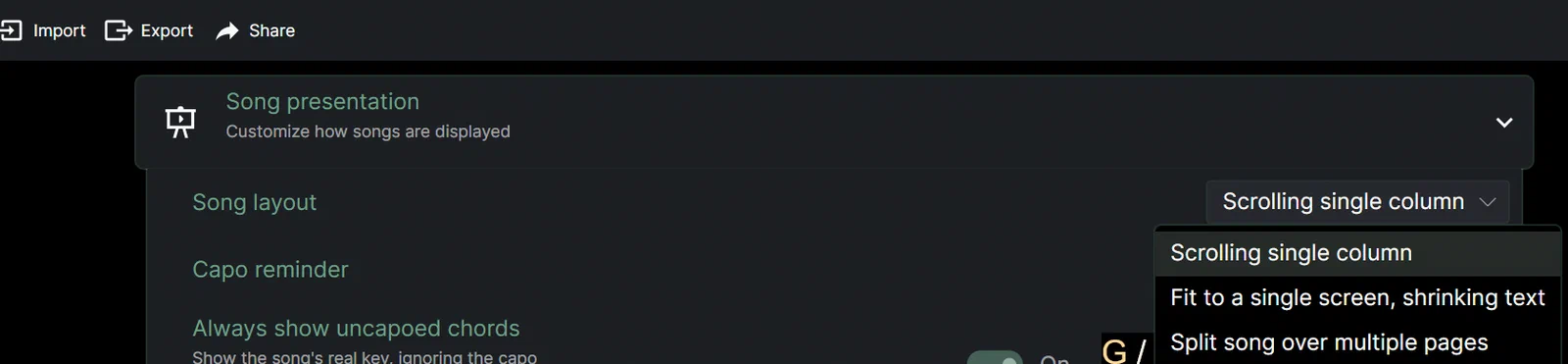
Choose how songs are presented with Song layout in the Song presentation section of the settings:
Chord notation
Chordle can show chords in a different notation from the one they were written in. Choose one with Display notation in the song presentation settings:
- Standard (A B C D E F G) - the default
- German (A H C D E F G) - B is written as H, and B♭ as B
- Latin (DO RE MI FA SOL LA SI)
- Nashville Number System - chords are shown as numbers relative to the song’s key, such as 1, 4, 5 and 6m
- Roman numerals - chords are shown as Roman numerals relative to the song’s key, such as I, IV, V7, vi and ♭VII. Major chords are uppercase and minor chords are lowercase
Nashville and Roman numerals work out each chord from the song’s key, so make sure the song has a key set. Because the numbers are relative to the key, they stay the same when you change the song’s key, which makes them handy for playing in whatever key suits the singer.
Changing the display notation only changes how chords are shown. The song itself is unchanged, so you can switch back at any time.