
You can edit an existing song by selecting it in your song library and then tapping the edit button:
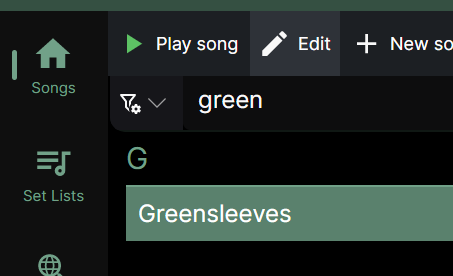
Keyboard & mouse You can also edit by selecting a song and pressing F2
Song text layout
Chordle supports editing songs in two formats, Chords above text and ChordPro format. You can switch between these formats at any time using the Edit as dropdown menu in the song editor:
Song metadata
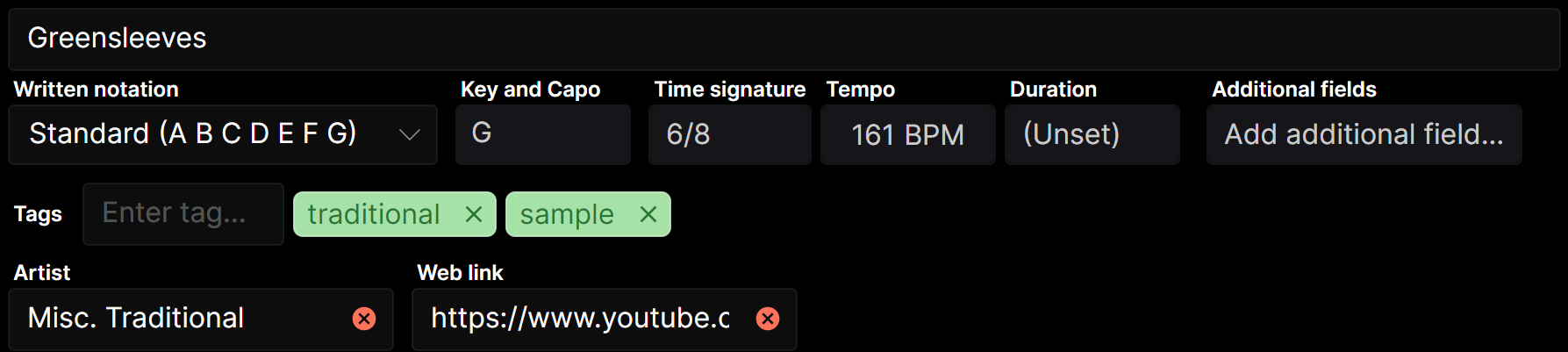
Key and capo
The song’s key corresponds to the chords as they are written in the editor. By default, changing the key will automatically transpose your written chords to match.
If you need to update the key without altering your existing chords, you can turn off the Update chords in song text option in the editor settings:
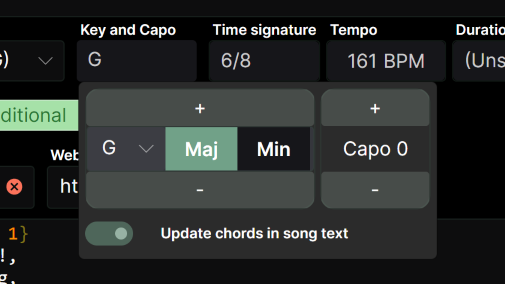
The capo position is purely informational while you’re editing. It just tells Chordle which default capo position to use when you actually play the song. The written chords are always the shapes you play relative to that capo.
Tempo and Time signature
The tempo of the song controls the metronome flash and is recorded in beats per minute (BPM). You can manually enter the tempo or tap the button in time with the beat of the song to set the tempo.
The time signature controls the number of beats in each bar. This is used when you are using a multi-beat metronome as in the above video, and controls how the beats are grouped.
Duration
Specifying the duration of the song in minutes and seconds (mm:ss) allows you to control the amount of time the song will scroll for when using scrolling layouts.
Web link
You can add a web link for a song, e.g. to a YouTube video. This shows up as a link when you are playing a song, so you can quickly open it.
Additional metadata fields
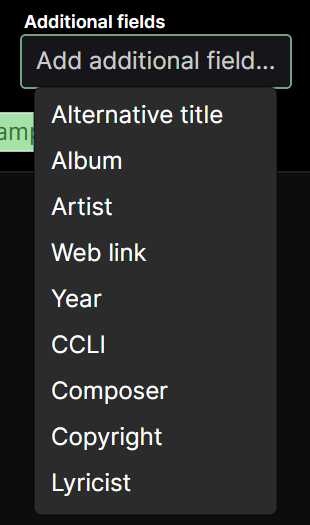
In addition to the song text, you can also add additional metadata for a song by tapping “Add additional field…” and choosing the field to add:
| Field | Description |
|---|---|
| Alternative title | An alternative title for the song. This is useful if a song is known by more than one name, e.g. “Amazing Grace” and “How sweet the sound”. When searching for a song in your song library, a song will appear listed twice, once by the main and once by the alternative title. |
| Album | The album the song is from. |
| Artist | The artist who performed the song. |
| Web link | A web link for the song, e.g. to a YouTube video. This shows up as a link when you are playing a song, so you can quickly open it. |
| Year | The year the song was released. |
| CCLI | The CCLI number for the song. |
| Composer | The composer of the song. |
| Copyright | Any copyright information for the song. |
| Lyricist | The lyricist of the song. |
| Notes | Free-form notes for playing the song, such as style, sound or transposition reminders. |
| Custom field | A field with a name and value of your choosing, such as the keyboard patch or groove. Pick it as many times as you need. |
Notes and custom fields can be shown at the top of the song with the song header.
Saving songs
When you are finished editing a song, tap the “Save” button in the toolbar to save your changes.

Keyboard & mouse You can also save by pressing CTRL+S.
Finding a chord
If you know how to play a chord but not what it’s called, tap Chord finder in the toolbar. Play the shape on the fretboard and Chordle names the chord, ready to insert into the song. See Chord finder for more.
Pasting chords from Word and other sources
When you copy chords-over-text from a source that doesn’t use a fixed-width font, such as a Microsoft Word document, the chords rarely line up once they land in the editor. This is because the spaces that positioned them were measured against a proportional font, not the monospaced text the editor uses.
The Paste button in the editor toolbar is a split button. Tap the main part to paste as normal, or tap the arrow next to it to choose Paste and realign chords (e.g. from Word):
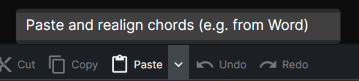
This realigns where each chord sat above its word in the original text and rebuilds the spacing so the chords sit over the correct words again.